Sunday, 11 July 2010

Sadly My Last Day in Babati … for now - Monday, 5 July


We get a late start up to the school as Jason has come in from Arusha. He has with him his daughter, Mary who looks just like him. We have a quick breakfast and head up to the school to finish the classrooms before heading out to speak to women’s groups in the community. I am quite excited and curious to speaking to women in the community, as it will provide terrific insight in to their lives.

We head up to the school and try to finish as much as we can this morning in terms of the painting. Disappointingly, we don’t finish the second classroom – just one coat before we need to head off. Just before we leaving we find out that we will only be meeting Hafia, as it is a holiday for the remaining women who will be fasting throughout the day.

Hafia and her family live up the hill from the school in a simple home, where she is the first to create a sustainable farm and put in to practice more efficient and sustainable ways of living through her fuel consumption and water use. When we arrive, 3 very hungry children are eating lunch in the kitchen – all with mouthfuls of ugali too busy to even notice we have arrived. Hafia shows us the massive progress she has made in terms of how they live by using a fuel efficient stove, water tanks that she has designed to heat her water while cooking and a toilet system that can is recyclable. Her home is neat and pristine, where her garden similar to the school is designed to utilize not only all of the land but feed off each of the different types of plants and animals.

Before beginning our discussion, we eat lunch a homemade meal of ugali and beans. Ugali is the traditional meal had at both lunch and dinner. It is a hardened version of porridge or cream of wheat. You eat it with your left hand, rolling in a ball in your hand putting a thumb print in the center and scooping up beans. It takes a lot of practice and it is quite messy but very filling and good.

After lunch we start to build one of the stoves, which is done with a fitted crate, sand and cement. We mix the combination and fit it in to the crate with a hole that allows the air to circulate. Hafia’s husband joins us and we determine that two stoves can be made per day. Each stove is sold within the community for 7k shillings and so far 7 stoves have been sold around the community. The goal is for the rest of the women’s group to sell them in order to teach the village how to be more efficient in terms of working and saving money in firewood. As they have started to sell them, they have each raised several thousands of shillings and we discussed how we can start them with bank accounts to make the most out of their money. The biggest challenge is getting awareness out and transporting the stoves to each persons home. We discuss how to get the awareness out and determine that each influencer/leader should have one in order to get awareness and how to use them in to the village. A very insightful and good discussion. As we are speaking her two children work with their father on the ABC’s, which is amazing to see that two small children sit working on their blackboard. As we leave, Amelia the youngest can’t pronounce my name so my new nickname is NiNi.

We had back to school to finish the day’s painting and complete the second classroom. We also discover the plant that will help minimize new castle disease which is killing the chickens. We end the day, I say my good byes to Jason and Mr. Marceli and hope to see them soon.
As it is my last night, we head back to Mary’s for a great finale meal splitting a Kili beer among the three of us. The meal is great – sambosa’s, rice and a new vegetable – pumpkin. After dinner, we have our last round of cards which I loser miserably again. Ahhhh a great trip to Babati, I sadly hug Julian and Fiona and hope to be back before I leave if it is possible. Up early tomorrow, as I need to be on the 6am bus to Arusha to catch my flight.

Sunday – Our Day of Rest 4 July


I get up early to a beautiful day of sunshine and after coffee head up to the internet café. The café is not open, which was a blessing as I hear beautiful music and discover that it is coming from the local church. I decide to walk over and sit in the back of the church to admire 4 women singing with one man playing a small, almost toy like piano. Everyone in church is dressed in their Sunday best, singing along, including all of the small children. A man comes over to welcome me and I realize that it is Mr. Sumaye who I don’t recognize at first, he in addition to everyone entering the church welcomes me with a large “Caribo” which is welcome. I stay for an hour listening to the beautiful music and reflecting on what and extrodinary and beautiful week I have had. It has been one after another of experiences I have never had before and will never forget. Some of them not easy but all opening my eyes to a completely different world from which we live.

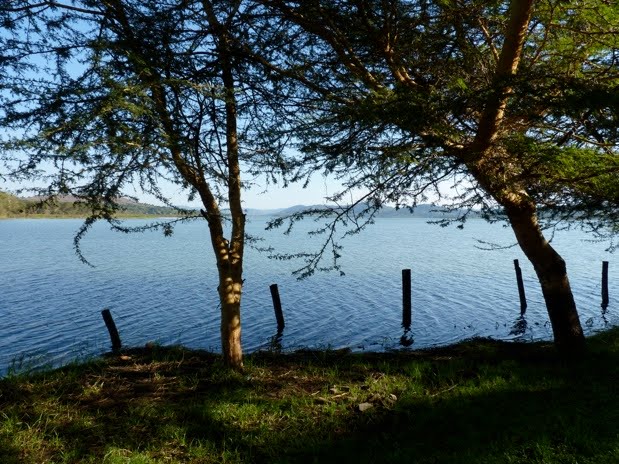
Restaurants are not typically open on Sunday, so we eat at one of the only ones that are open today before heading up to Lake Babati. The City sits about 6-7 km from Lake Babati, where it is know for its beauty, tranquility and hippos. We walk through town and through a small village to arrive at the Royal Beach Resort – it is resort built to attract tourists – all feeling quite man made and is a place barely occupied except by locals who get dressed up to have a cold drink or beer on a Sunday afternoon with their families are pristinely maintained to create the perfect setting overlooking the lake. Selfishly I am hoping for the Wimbeldon finals to be on but no luck so back to reading my book. We sit basking in the sun, enjoying the lake, watching fisherman go by in wooden canoes and we have a special treat. A hippo swims by, not 20 yards away, raising its head as if to say hello before swimming off. Children gleefully laugh while we attempt to snap photos – just a normal Sunday afternoon in Tanzania.

Just before sunset we walk back where again the light is magical. Outlining people coming back from church or work to join their families for dinner. In the village, houses are crowded with families and neighbors enjoying a lazy Sunday afternoon while Samaki – fish fries and ugali and rice are stirred to perfection.

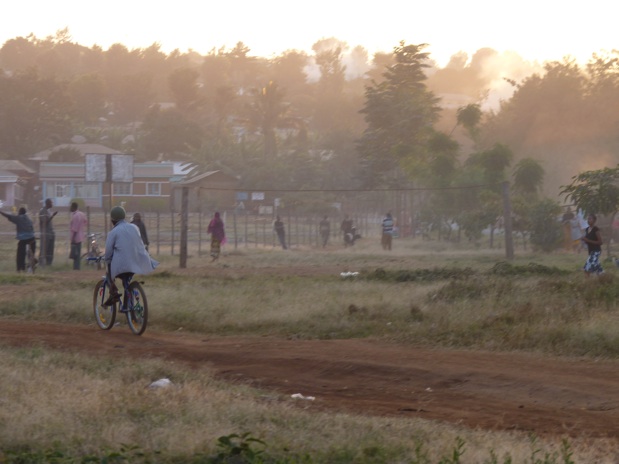
Getting in to town there is the most beautiful sunset where the sun cuts through the dust coming from the soccer field and road, outlining a family walking home, students playing in the field and a biker – gorgeous is the only word to say.

Of course, we head back to Mary’s for spicy samsosas, bega, rice and beans. La La Salama (have a good rest0 as we prepare for the week ahead.

Waeingwaray – July 3


It is a gloriously sunny day – cold but blue, blue skies and bright sunshine. We head up to Waeingwaray (the school) right after breakfast to hopefully finish the 3 classrooms. A good start as we finish all the filling and begin painting. Out of three classrooms there is in very bad shape, where Jason and I have to literally rebuild the windowsills and corners – not an easy task without tools but a good challenge. We succeed and move on to helping paint. In order to keep the classrooms bright and cheery, we paint everything bright white with red notice boards. It really is amazing on what a difference it makes.

The students are on holiday, however, they are preparing for exams so there are several classes prepping for their exams next week. I have the pleasure of meeting the head teacher, Mr. Samaye and Hafia the Kindergarden teach, who also heads up the school development program. They have done an amazing job at turning the school around over the past 3 years to the best school in Babati. Through Julian’s efforts, donors and donations, they have been able to raise enough money to put the teachers on payroll, which is not a requirement of the school. In addition it has also help enroll and pay for 50 more students. Just before lunch some of the students stop by and are excited to see our progress – they love having their picture taken and want to help as much as they. They help with some the painting and are quite proud.

Working through the morning we almost finish the first classroom before heading to lunch. We head to the Café down the road where we have a special treat – sweet potatoes with chili sauce to accompany our chapattis and mchichi (cabbage). The chili sauce is made fresh by the woman who sells the schools fresh produce which she made on the spot with tomatoes, chilis and shallot – is not just spicy but fiery. She and the cook at the café laugh at us as we try to cool the heat with our chapittis. I am going to miss this little café where the local workers gather for lunch everyday, the food is made from heart and besides being delicious cost $1 USD per day including a coke or chai.

After lunch, Jason has to head to Arusha to pick up his daughter, we get back to work to hopefully complete the painting in the first classroom. The afternoon is bright sunny and perfect weather, we are victorious in finishing the first classroom and sit back to admire our work. We walk back in to town as Jason was our ride, tired but feeling like we have accomplished today’s goal. The late afternoon evening light is magical as it turns slightly red, reflecting off of the red earth and setting behind the mountains. As we walk through the villages, we stop to buy fresh tomatoes and bananas to have for breakfast tomorrow. Before getting to the guest house, Fiona and I decide to head to the market to purchase katanga’s the colorful fabric the women wear. On the way, we meet two local women with their babies, they show us the way to the best shop and despite the fact that we don’t share the same language they help us pick beautiful pieces at local prices and even show us how to tie them the proper Afrikani way. We say our goodbyes and head back to the guesthouse, where we head for a beer and dinner. Tomorrow is our day off and I believe all of us are looking forward to a day of relaxing.

Returning to Babati – July 2


I am scheduled to be back in Babati for a days work by 9am, so we head out at 6am to ensure that we are at the bus stop by 7am – the morning is freezing, which is good as it makes us trek a bit faster. Howling (the guide), Mr. Marceli and I get on the “bus” – the minivan, where I ride up front with a woman headed to Babati to sell mats and a young man with his chickens ready for the market. About halfway to Babati, the young boy asks the bus to stop and for the woman and I to hold his chickens as he jumps out for a quick wee – so my first time traveling with chickens on public transport turns into actually holding them – the woman and I laughed the rest of the way home although we did not understand what each of us were saying. Chickens and all we arrive on time and meet Julian and Fiona for a quick chai before heading up to Waeingwaray, the school and farm with Living Stone Tanzania Trust (3 days without running water but hey whats one more).

We get to work with the goal of finishing the gates for the new water irrigation system and to start refurbishing 3 classrooms, one of which needs a majority of the walls rebuilt. We get to work on the gate and it is quite hysterical - as I like to call it 3 blind mice – given that none of us know carpentry in the least bit. 3 hours later and a lot of repairs we have completed the gate putting the finishing touches of “doo doo paint” – a thick black paint that prevents the termites destroying – luckily its lunch as we need a much needed break from the hammer and saw.

We hit the local café – the only restaurant in walking distance. It seats 4 unless you are willing to squat. The food is homemade and delicious – steaming hot chai, chapattis and “samaki” baby fish with pepper sauce. Back to work as we have a lot to accomplish this afternoon on the 3 classrooms and the outside walls.

Jason Kehembe, the local project leader and myself begin rebuilding walls while Julian and Fiona begin the painting. We make a lot of progress and are quite clever working without proper tools – you can’t imagine how you can fill walls with your bare hands! Needless to say we will have a lot sanding to do in the morning. We get through all the filling and I survive a few battles with a few spiders who are not happy about leaving their corners (and not to pretty too look at). A good day all and all a great day.

Once back in town, we celebrate with a cold Kilimanjaro at the bar next to the guesthouse. Off to dinner at the local restaurant which we refer to as Mary’s, where everything is homemade and Mary the manager is amused at our obsession with samasosa’s and chili sauce. I may have met my match with the chili sauce, as Fiona and Julian like it just as hot – no wonder we are all getting on! And this may be one of hottest I have had (interestingly it seems to get hotter every time we return – a test – ha!)

We have an early start Saturday morning so we have an exciting game of yahtzee – who knew how hard yahtzee could be. After losing in a row, I head to bed in a haze of yahtzee defeat.

Wednesday, 7 July 2010

Dareda A Slice of Heaven In the Clouds – 1 July


We head to Dareda on the 6am bus, thankfully it is a normal size bus and relatively not too crowded. A short 90 minute trip and we arrive in Dareda, a small village halfway between Babati and Katush. We head to the local Chai shop before we make the 45 minute trek to the Marceli home.

It is a cold morning and the chai shop is jammed with men lined up neatly sipping steaming cups of chai watching the replay of the World Cup. It is buzzy and you immediately know this is where the village gathers before starting a days work. The chai served with steamed milk and sugar is steaming and delicious. It is made in large vats in the back over an open fire and accompanied with a crispy chapatti made right there. The chapatti men get excited when I peak in to the kitchen and proudly show me the process of rolling, cutting and cooking. Chai and chapatti’s don’t get better than this.

Martin, Mr. Marceli’s 4th son, escorts up to their home. We walk through small villages in the most picturesque mountain location, the area is green and lush, with the mist lifting over the mountain as the sun rises, with farmers working their fields by hand. We arrive at their home, a large house (to accommodate 11 children), it is simple with many bedrooms, a large kitchen outside. Their water is gathered through one tap in the backyard and last year they just put in a petrol generator to have minimal electricity on special occasions – one of which is to ensure the TV is working for the world cup! As the only home to have electricity in the village, they open their home to their neighbors making their sitting area welcome for all to come watch. They are the epicenter of the village where most children and neighbors gather to chat, play and to dance.

We head off to see the coffee plantation, which is down the road. Opening 80 years ago, they have been successful at harvesting first grade Tanzanian coffee. The fields are filled with laughter and singing, as it is harvest time and locals are picking the beans, across the array of green you can make out the colorful headscarves of the women peaking over the top. For each bag filled they will make 1k shillings – the equivalent to $ .75.

Following the plantation, we visit the Marceli mixed farm, which was the first in the area and where he has been certified since the 80’s. The farm produces food for the family and provides demonstration lots to villagers in order to create more food and efficiencies in the community. They harvest fruits – bananas, mangos, passionfruit, lemons, papayas and vegetables – yams, sweet potatoes, tomatoes, cabbage and avocados. In addition, they have 4 fish farms with close to a 1000 fish, cows, chickens, goats and 3 pigs. The fruit and vegetable are free range and organice – creating the sweetest passionfruit and lemons the size of softballs. We gather ingredients for dinner – yams, fish and cabbage and head back for lunch.

After lunch, we visit the local primary school which recently has been refurbished with the help of an American group from LA. They have built 4 classrooms, including a kindergarden and teacher accommodations. It is a great facility with the hopes of attracting even better teachers. Their playground is a beautiful field where they play soccer among the mountains and the cows.

It is 5pm and it is time for the ceremonial dance, where all the villagers come together at the Marceli’s to do a traditional dance. It is saved for special occasions and when guests are here. In Tanzania, it is considered a blessing for the house to have a guest, so they thank the guest by performing a dance done by both women and men. It is only drums but the music created as it is done by jewelry, beads worn on the neck and singing. It is beautiful to say the least. I am asked to join and reluctantly I go – I do have two left feet as my brother can attest too – but as I can’t say no. To my surprise I am given the ceremonial beads to wear and are given them in a rather ritualistic way. The dance is hilarious, as it is jumping up and down towards the men, stepping forward and around in a circle – I still seem to lack coordination! Being this welcome is overwhelming and brings to tears as a village sings on and children clap. It is the simple threads that brings us all together – isn’t it?

After the dance, we bravely forge in to the woods to harvest honey. They keep killer bee hives who produce the sweetest honey we have ever tasted. This is only done at night when the bees are sleeping – SCARY. We walk in the dark – minimal torches – guided by the moon (and of course Alfred who I am practically walking on top of). The stars are bright and there are fields of fireflies lighting up the way. To harvest honey, you literally smoke the bees out – no thanks – I stand as far away as possible and hope for the best. There are 5 of the men who are laughing while they pull out honeycombe and swat the bees from their clothes – it is all rather petrifying and I am glad after an hour it ends. The guys use no suits, nothing and even as they taste the sweetest, they are stung several times in the mouth – ouch. Now here is an outstanding business proposition – Organic, Free range, KILLER BEE honey (isn’t Waitrose jealous) and by the way we are enjoying every morning!

Back home for dinner – all the food Martina and I have prepared – all delicious – of course ☺. A great day in the village of Dareda, where the people share what they have, love each other and dinner with your family - remind us all what life is about. As I said, a slice of heaven………..

Monday, 5 July 2010

30 June - The Barbaig Tribe


I wake up early to a beautiful sunrise after a restful night rest – the bugs made me nervous. We have some tea and head off for Mr. Hiluku to show me how the local beer is made. It is made with water, honey and special herbs and brewed for 24 hours in the sun in an oversized pod. Once brewed, the men pass around cow horns filled with the beer toasting the occasion and do so until the beer is finished. As a woman, I am not allowed to taste it but it smells sweet, almost like a cider rather than a beer. While we do this, the women continue to prepare food, clean and care for the animals.

As one of the oldest tribes, they are great warriors and continue to hunt with bows and arrows. Historically, this is how the tribes would fight each other but now all the tribes in Tanzania respect one another, so the bows and arrows are used to hunt small animals, including wild pigs to eat. I give it a go and it is very hard, I actually can barely pull the arrow back so instead coming anywhere near the target, it falls to the ground. Following my lesson, we head off for Mr. Hiluku to show me his land and the school where his daughter will start to attend next year. The school is in great shape and Peter, who is the head teacher, welcomes us to say hello to a class that is preparing for their exam. It is amazing to see in the middle of the bush a classroom filled with students who are learning English.

Afterwards, we head back for lunch, which I help prepare in grinding the maize for the Ugali. Ugali is a type porridge made from ground maize, cooked and allowed to sit to become firm. You eat with your hands by taking a small piece in your right hand, rolling in a ball and dipping in to the vegetables. It is quite hard to eat and quite filling but the vegetables are good.

We head back in to town after lunch, where we will stay for the night. Katush is crowded with the center of town being the bus stop where locals walk around selling oranges, roasted peanuts , water, biscuits and juice. Everyone is very friendly yelling “jambo” and “caribou” (welcome). We visit the local maker of kanga’s and kanzu’s, which are the traditional garments worn by the women and men . Kanga’s are brightly covered with slogans or sayings on them that are worn by women as skirts. Kanzu’s, worn by the men are brightly colored kaftans. Afterwards, we head for dinner and off to an early night as we have a very early start tomorrow to head to Mr. Marceli’s house.

29 June – In to the Bush


Very excited to start my 3 day cultural tour, we will spend the next 3 days living with the local families. The journey starts with a 2 ½ hour trip to Katush, where we will meet the Hiluku family, who are part of the Barbaig tribe, one of the oldest tribes in Tanzania.

The bus is a 15 seater mini-van where 30, yes 30 people plus 3 chickens pack in to, I did not think it could be done but it was. The roads are not in great condition so the journey is slow, dusty and quite hectic with lots of stops along the way among small villages dropping off supplies or picking up people heading to Katush. We arrive in Katush just after lunch, it is a small city where most of the people live in the surrounding area and come into town for groceries or shopping. It sits close to Montana mountain which is the 4th highest mountain in Tanzania. We pick up the food we need and head for a 6k walk to meet the Hiluku family.

The trek cuts through fields of maize, passing cattle herds, small houses and those who are walking back and forth from home in to town. We arrive at the Hiluku home, which consists of 3 mud huts, where the family and their animals live. One hut contains the kitchen and sleeping area for the elder mother, the other where there is a small fire to keep warm and sit and the third another sleeping area. The tribe encourages multiple wives, so I meet the elder mother who is Mr Hiluku’s first wife, she is the keeper of the home and does most of the chores, cooking and cleaning. They have 6 children who live nearby. Elysa, Mr Hiluku’s second wife, also live here in a newer mud hut with their two children Dabali, 3 and Elysa, 7 (with another on the way). They lead simple lives, having several acres of land where they grow different crops and raise cows and goats to feed their family. In addition, they make local beer that they share, men only, with neighbors to celebrate special occasions. Mr Hiluku is not home, as there is a special guest celebration at a neighboring home.

We prepare dinner, which is rice, cabbage and beef. All of which is done over a small fire in 3 small pots. Tradition is to wait for the man to return before eating, so we wait until Mr. Hiluku arrives home. As the sun sets over the mountains it is beautiful, peaceful with the sounds of children laughing, birds and hienna’s in the distance. Once dark, the skies becomes alive with millions of stars, more than I have ever seen – luckily there is almost a full moon so it is bright outside, as there is no light as we sit and talk.

After dinner, it is late so we all head to bed where I, as a guest, am sleeping in the sitting area on a cow skin near the fire. In fear of bugs – which they are a lot of – I set up my mosquito net, which looks rather ridiculous in the mud hut while the family, Mr Hiluku’s brother and friend all sleep. An interesting night of listening to Swahili banter and laughter of good friends and family.